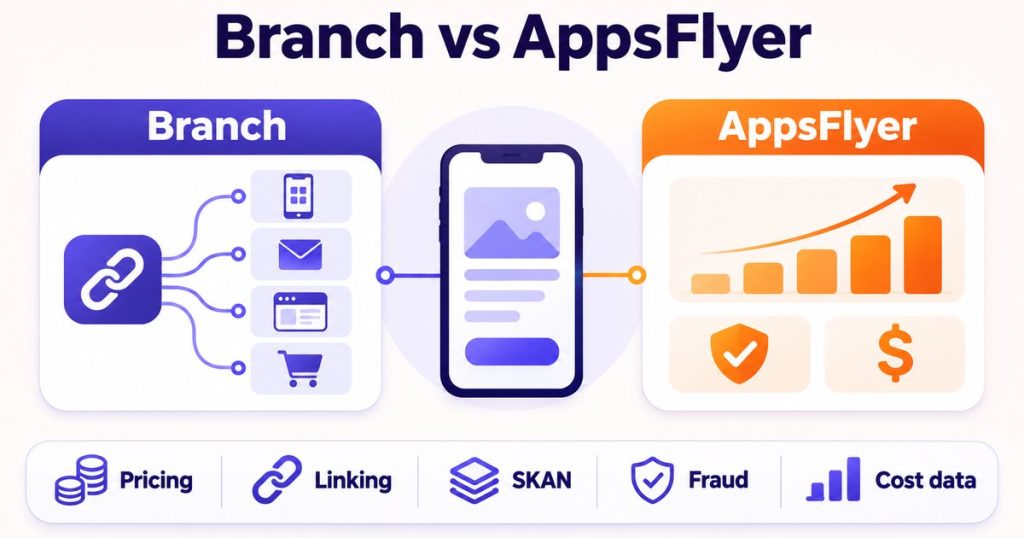
Branch vs AppsFlyer: 5 Key Differences for an Easy Choice
Table of Contents
ToggleBranch vs AppsFlyer is a hard comparison to read online, because most articles are written by one of the two vendors or by a site that earns a referral fee. This one works from the vendors’ own documentation. Anything that is only a marketing claim is labelled as one.
The short version of the Branch vs AppsFlyer question: both platforms do attribution, SKAdNetwork reporting, fraud protection, cost data and deep linking. They differ in where each one starts, what is public, and what sits behind a paid plan. Branch facts were checked on 2 November 2026. For AppsFlyer, pricing was re-checked the same day, and the fraud, cost and SKAN documentation was last checked in October 2026.
Branch vs AppsFlyer at a Glance
- Starting point. Branch presents deep linking as its foundation. AppsFlyer presents itself as a full measurement platform, with OneLink for deep linking.
- Published pricing. AppsFlyer lists three plans and a per-conversion rate. Branch’s marketing page shows no prices and points to enterprise agreements and a demo.
- SKAdNetwork. Both support it. Branch’s SDK manages Apple’s conversion value calls by default, and AppsFlyer offers Conversion Studio.
- Fraud. Both detect fraud before it earns credit. AppsFlyer labels Protect360 as Premium. Branch does not state plan limits for its fraud tools.
- Cost data. Both have it, and both put it behind a paid tier: ROI Hub for Branch and ROI360 for AppsFlyer.
If you are new to the category, read what mobile attribution is first, then come back.
What Is Branch?
Branch is a platform that combines deep linking with attribution and measurement. Its own apps page describes deferred deep linking, a privacy-first routing feature called NativeLink, branded short links, and email and SMS links that open the app. It also describes attribution tied to owned links, an iOS measurement mode it calls Privacy-Aware Measurement, fraud filtering and cost reporting. The numbers on that page, such as 3.5 billion monthly reachable users, more than 100,000 companies and more than 2,000 technology integrations, are the vendor’s own figures, and I could not verify them independently. For the setup side, see the Branch deep links setup guide.
What Is AppsFlyer?
AppsFlyer is a mobile measurement partner that attributes installs and in-app events, reports SKAdNetwork data, detects fraud with Protect360, aggregates cost data through ROI360 and handles deep links through OneLink. Its marketing says it integrates with more than 11,000 technology and media partners, which is again a vendor figure. For the SDK side, see the AppsFlyer setup guide.
Branch vs AppsFlyer Pricing: What You Can Actually Verify
AppsFlyer Pricing
AppsFlyer publishes three tiers on its pricing page. Zero is free, aimed at owned media, and the page says it is not suitable for apps with paid activities. Growth is pay as you go: after a Welcome Package of 12,000 free conversions for the first year, each conversion costs $0.07. Enterprise is custom priced through a demo request. The page does not say which features each plan includes in a form I could read, so check the plan table before you rely on any single feature.
Branch Pricing
Branch’s apps page gives no prices, tiers or free plan. It mentions predictable enterprise pricing and enterprise agreements, and sends you to a demo. Branch’s own help pages are more specific about one thing: its ROI Hub for cost data requires a premium plan, and the page refers you to Branch Sales for pricing. Third-party price trackers disagree with each other, so I am not quoting numbers. Ask for a written quote that states usage limits, overage rates and every add-on you plan to use.
Deep Linking in Branch vs AppsFlyer
This is the biggest difference in positioning. Branch’s documentation lists direct deep linking through URI schemes and Universal or App Links, and deferred deep linking on iOS through its NativeLink feature, which uses the iOS pasteboard. On Android it uses install referrers for deterministic matching. It also describes a Branch-wide device ID match for users who clicked a Branch link before, and two probabilistic methods: a predictive modeling engine that uses IP addresses and user agents, and a browser-to-app snapshot comparison.
AppsFlyer’s deferred deep linking page presents OneLink as capturing the original click parameters and restoring them after install, across channels such as email, SMS, QR codes and referral campaigns.
Both do the job in the Branch vs AppsFlyer comparison. Neither can be called more mature without testing your own link flows. If linking and web-to-app journeys are the center of your product, test both with your real channels and destinations before you decide.
Attribution Methods and Their Limits
Branch’s help center is unusually direct about accuracy. Its page on attribution methods separates the methods it describes as deterministic from the two it describes as probabilistic, and it says attribution windows can be changed per integration in the dashboard. It does not give numeric lookback windows. It also tells developers to parse the +match_guaranteed value at SDK start and deep link only when it is true, if wrong matches would be costly.
That is a useful way to read any attribution claim in the Branch vs AppsFlyer debate, including AppsFlyer’s. Ask each vendor which matches are deterministic, which are modeled, and how a modeled match is labelled in the data you export.
SKAdNetwork: Branch vs AppsFlyer
Branch’s SKAdNetwork SDK configuration page says the Branch SDK is opted in by default to call Apple’s methods automatically. If you opt out, the SDK stops updating the conversion value, you call Apple’s methods yourself, and you define what each value means. Branch reports the value it receives from the ad network. The page also says Apple has no server-side API for reporting conversions, so the app itself must report them. It does not discuss AdAttributionKit in its text.
AppsFlyer’s SKAN solution guide describes Conversion Studio, where an advertiser sets what the conversion value measures without changing app code. It offers a Flexible SKAN 4.0 mode that AppsFlyer calls best practice, a Flexible Custom mode, legacy Fixed modes and a Decode option for a custom schema. AppsFlyer also documents sending SKAN and AdAttributionKit postback copies to the platform. For the Apple side, read the SKAdNetwork setup guide.
Fraud Protection in Branch vs AppsFlyer
Branch’s fraud documentation lists five patterns: fake devices and click farms, install hijacking and click injection, click flooding, ad stacking and device reset. Each is paired with a signal, such as blacklisted IPs or unusual click-to-install times. A related article describes fraud rules that block attribution credit in real time and stop bad postbacks to ad networks. The overview does not say whether fraud detection is on by default or whether any plan limits it.
AppsFlyer’s Protect360 guide lists device ID reset fraud, install hijacking, click hijacking, click flooding, behavioral anomalies, IP denylists, SDK authentication and store validations. It says fraudulent installs are identified in real time and blocked from attribution, and that fraud found after attribution can be flagged for up to seven days. The guide labels Protect360 as Premium and does not describe pricing.
The practical difference in Branch vs AppsFlyer fraud tools is the packaging, not the idea. Ask each vendor for a written list of what is included in your plan.
Cost Data in Branch vs AppsFlyer
Branch’s help center says cost data reaches the dashboard through API connections for supported partners, file upload and scheduled email import, and that direct integrations cover over 20 of the largest ad partners. ROI Hub brings cost and revenue together, and access requires a premium plan. Branch’s marketing page says cost data is refreshed daily for active partners, while also describing real-time reporting, so confirm the actual delay with Branch.
AppsFlyer’s cost aggregation overview describes a Cost API, an InCost API, CSV import and cost recorded on attribution links, with a priority rule that stops double counting. It requires an ROI360 subscription, and without it only CPI-based cost remains visible.
In both cases the question is not whether cost data exists. It is how many of your sources each one pulls automatically, and what that costs on your plan.
What Each Vendor Says About the Other
AppsFlyer publishes a page titled “How AppsFlyer compares to Branch”. It is marketing, and every claim about Branch is AppsFlyer’s own characterization. It says, for example, that Branch’s SKAN approach combines data sets instead of reconciling them, that AppsFlyer’s OneLink API handles far more requests per second, that Branch hashes identifiers only after seven days, and that Branch publishes no linking-only plan. I could not verify these, and Branch’s own pages do not answer them one by one. Treat them as questions to put to Branch, not as findings.
The same caution applies to Branch’s claims about AppsFlyer and to both vendors’ partner counts. Skip the totals and check the specific ad networks, cost sources and analytics tools you use. The mobile attribution audit guide has a checklist for that.
Which One Should You Choose?
There is no universal winner in the Branch vs AppsFlyer choice, so decide on the gap that costs you the most today:
- You want a published entry price and a free start. AppsFlyer is the only one of the two with plans and a per-conversion rate on a public page.
- Deep linking and web-to-app journeys are the core of your product. Branch leads with them, and AppsFlyer offers OneLink. Test both on your own flows.
- iOS conversion value design is your biggest problem. Compare Branch’s default SDK-managed mode and opt-out path with AppsFlyer’s Conversion Studio.
- Cost data is the main reason you are buying. Both put it behind a paid tier, so compare the exact ad sources you need.
- You are comparing three platforms. See Singular vs AppsFlyer and AppsFlyer vs Adjust.
Whichever you pick, run a short trial on one app, fire a test event end to end and check it against the free mobile app attribution debugger before you move your budget. A wrong configuration costs more than the price gap between the two.
FAQ
Which is better, Branch or AppsFlyer?
Neither is better for every app. Both cover attribution, SKAdNetwork reporting, fraud protection, cost data and deep linking. Branch leads with deep linking, and AppsFlyer leads with measurement and publishes its pricing. Compare written quotes and test one app on each before committing.
Is Branch cheaper than AppsFlyer?
That cannot be verified from public pages. AppsFlyer publishes a free Zero plan and a Growth plan at $0.07 per conversion after a first year Welcome Package of 12,000 free conversions. Branch’s marketing page shows no prices, so a direct comparison needs a written quote from Branch.
Does Branch do attribution, or only deep linking?
Branch does both. Its help center documents attribution methods, a SKAdNetwork integration, fraud rules and cost reporting alongside its deep linking. Its marketing describes attribution as anchored to owned links.
Do both platforms support SKAdNetwork?
Yes. Branch’s SDK calls Apple’s conversion value methods by default and lets you opt out to manage values yourself. AppsFlyer offers Conversion Studio for designing conversion values and documents SKAN and AdAttributionKit postback copies.
Which has better fraud protection?
The documentation does not support naming a winner. Branch lists five fraud patterns and fraud rules. AppsFlyer lists a wider set under Protect360 and labels it Premium. Ask each vendor for a written list of what your plan includes.
Does cost data come included?
Not by default on either platform. Branch states that its ROI Hub requires a premium plan. AppsFlyer requires an ROI360 subscription for its cost data suite.
Can I switch from one platform to the other later?
Yes, teams switch as their needs change. Expect to re-implement the SDK, remap events and reconnect ad networks. Export the historical data you need before cutting over, and check each vendor’s guidance on running two SDKs side by side.
If you are deciding between the two, or you have one set up and the numbers do not look right, send your setup description to contact@alfahadhridoy.com and I will reply by email with what to check.