Table of Contents
ToggleRudderStack vs Segment: Which CDP is Best for Mobile Apps? (2026)
If you’re building a mobile app and need to route event data to multiple destinations – analytics tools, ad platforms, data warehouses – you need a Customer Data Platform (CDP).
Segment and RudderStack are the two most popular choices. But which one is right for your mobile app?
This guide breaks down RudderStack vs Segment across pricing, mobile SDK quality, integrations, data ownership, and real-world use cases — so you can make the right decision for your stack.
In this guide:
- What Segment does and why teams use it
- What RudderStack does differently
- RudderStack vs Segment: direct comparison
- Mobile SDK quality comparison
- Pricing breakdown
- Which one to choose for your use case
- How to integrate with AppsFlyer and Firebase
What Is Segment?
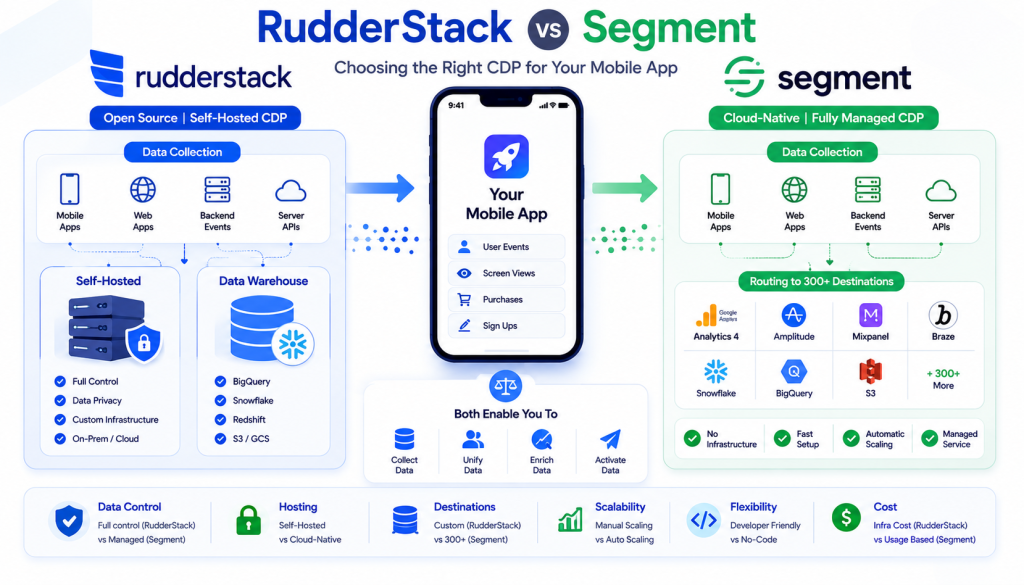
Segment is the most widely used Customer Data Platform. It collects events from your mobile app, website, and server, then routes that data to 400+ destinations — analytics tools, ad platforms, CRMs, and data warehouses.
Why teams use Segment:
- Largest integration library (400+ destinations)
- Easy setup with minimal engineering
- Strong documentation and community
- Hosted solution — no infrastructure to manage
- Trusted by thousands of companies globally
What Segment does:
- Collects user events via iOS, Android, web, and server SDKs
- Routes events to destinations like Amplitude, Mixpanel, Facebook, Google Ads
- Stores data in your warehouse (BigQuery, Snowflake, Redshift)
- Provides audience segmentation via Twilio Engage
What Is RudderStack?
RudderStack is an open-source Customer Data Platform. It does everything Segment does — but with a warehouse-first architecture and the option to self-host.
Why teams use RudderStack:
- Open-source with full data ownership
- Self-hostable — your data never leaves your infrastructure
- Warehouse-native architecture
- Significantly cheaper at scale
- 200+ integrations
What RudderStack does:
- Collects user events via iOS, Android, web, and server SDKs
- Routes events to destinations
- Sends data directly to your data warehouse
- Supports real-time event streaming
- Provides transformations and filtering
RudderStack vs Segment: Direct Comparison
| Feature | Segment | RudderStack |
|---|---|---|
| Open-source | ❌ | ✅ |
| Self-hostable | ❌ | ✅ |
| Integrations | 400+ | 200+ |
| Mobile SDK | ✅ Strong | ✅ Strong |
| Warehouse-native | ⚠️ Via Connections | ✅ Core feature |
| Data ownership | ❌ Segment’s servers | ✅ Your infrastructure |
| Free tier | Limited | ✅ Open-source free |
| Pricing at scale | Expensive | Much cheaper |
| Setup complexity | Easy | Medium |
| Community & docs | Excellent | Good |
| GDPR compliance | Good | Excellent |
Mobile SDK Comparison
For mobile apps, SDK quality is critical. Both Segment and RudderStack have strong mobile SDKs, but with differences.
Segment Mobile SDK
iOS:
// Installation via CocoaPods
pod 'Segment-Analytics'

// Initialization
let config = AnalyticsConfiguration(writeKey: "YOUR_WRITE_KEY")
config.trackApplicationLifecycleEvents = true
Analytics.setup(with: config)

// Track event
Analytics.shared().track("Product Purchased", properties: [
    "revenue": 29.99,
    "currency": "USD",
    "product_id": "premium_plan"
])

// Identify user
Analytics.shared().identify("user_12345", traits: [
    "plan": "premium",
    "email": "user@example.com"
])
Android (Kotlin):
// Installation
implementation 'com.segment.analytics.android:analytics:4.+'

// Initialization
val analytics = Analytics.Builder(context, "YOUR_WRITE_KEY")
    .trackApplicationLifecycleEvents()
    .build()
Analytics.setSingletonInstance(analytics)

// Track event
analytics.track("Product Purchased", buildJsonObject {
    put("revenue", 29.99)
    put("currency", "USD")
    put("product_id", "premium_plan")
})
RudderStack Mobile SDK
iOS:
// Installation via CocoaPods
pod 'Rudder'

// Initialization
let config = RSConfig(writeKey: "YOUR_WRITE_KEY")
    .dataPlaneURL("https://your-dataplane.rudderstack.com")
RSClient.sharedInstance().configure(with: config)

// Track event
RSClient.sharedInstance().track("Product Purchased", properties: [
    "revenue": 29.99,
    "currency": "USD",
    "product_id": "premium_plan"
])

// Identify user
RSClient.sharedInstance().identify("user_12345", traits: [
    "plan": "premium"
])
Android (Kotlin):
// Installation
implementation 'com.rudderstack.android.sdk:core:1.+'

// Initialization
val rudderClient = RudderClient.getInstance(
    this,
    "YOUR_WRITE_KEY",
    RudderConfig.Builder()
        .withDataPlaneUrl("https://your-dataplane.rudderstack.com")
        .build()
)

// Track event
rudderClient.track("Product Purchased",
    RudderProperty()
        .putValue("revenue", 29.99)
        .putValue("currency", "USD")
)
SDK Comparison:
| Feature | Segment SDK | RudderStack SDK |
|---|---|---|
| Auto-tracking | ✅ Lifecycle events | ✅ Lifecycle events |
| Offline support | ✅ | ✅ |
| Background upload | ✅ | ✅ |
| SDK size (iOS) | ~2MB | ~1.5MB |
| Flutter support | ✅ | ✅ |
| React Native | ✅ | ✅ |
| Documentation | Excellent | Good |
Pricing Breakdown
This is where RudderStack wins significantly.
Segment Pricing:
- Free: 1,000 MTUs (Monthly Tracked Users)
- Team: $120/month for 10,000 MTUs
- Business: Custom pricing, typically $20,000+/year
- At scale: Can reach $50,000-$100,000+/year for large apps
RudderStack Pricing:
- Open-source: Free — self-host on your own infrastructure
- Cloud Free: 10,000 events/month free
- Cloud Pro: $750/month for higher volumes
- Enterprise: Custom pricing
Cost comparison for 100,000 MAU app:
- Segment: ~$1,000-$2,000/month
- RudderStack Cloud: ~$750/month
- RudderStack Self-hosted: Infrastructure cost only (~$50-200/month)
RudderStack vs Segment: Use Case Breakdown
Choose Segment when:
- You’re early stage and want fastest setup
- You need 400+ integrations immediately
- You don’t have engineering resources to manage infrastructure
- Budget is not a primary concern
- You want the largest community and best documentation
Choose RudderStack when:
- Data ownership and privacy are priorities
- You’re scaling fast and Segment’s pricing is becoming painful
- Your engineering team can manage self-hosted infrastructure
- You’re already using a data warehouse (BigQuery, Snowflake)
- You operate in regions with strict data residency requirements (GDPR)
RudderStack vs Segment for Mobile Attribution
Both CDPs integrate with mobile attribution tools, but with differences.
AppsFlyer Integration:
Segment → AppsFlyer:
- Enable AppsFlyer destination in Segment dashboard
- Segment automatically maps standard events to AppsFlyer events
- Works out of the box for most standard events
RudderStack → AppsFlyer:
- Enable AppsFlyer destination in RudderStack dashboard
- Requires manual event mapping configuration
- More flexible but requires more setup time
Firebase Integration:
Both Segment and RudderStack can send events to Firebase Analytics, but for mobile apps it’s more efficient to use the Firebase SDK directly alongside your CDP rather than routing through it.
Recommended stack:
Mobile App SDK → RudderStack/Segment → Multiple Destinations
                                     → Amplitude (product analytics)
                                     → Facebook Ads (advertising)
                                     → BigQuery (data warehouse)

Firebase SDK → Firebase Analytics → GA4 (direct integration, bypass CDP)
RevenueCat → Subscription events → MMP + Analytics tools
Migration: From Segment to RudderStack
If you’re considering migrating from Segment to RudderStack, the process is straightforward because both use the same event spec.
Migration steps:
- Set up RudderStack data plane (cloud or self-hosted)
- Replace Segment SDK with RudderStack SDK
- Update write key in your app
- Recreate destinations in RudderStack dashboard
- Run both in parallel for 2-4 weeks to validate data
- Switch fully to RudderStack
The event tracking code is nearly identical — the API is compatible, so minimal code changes are needed.
Common Mistakes When Using a CDP for Mobile Apps
Mistake 1 — Routing Attribution Events Through CDP
Never route MMP attribution data (installs, deep links) through a CDP. Use the MMP SDK directly. CDPs are for behavioral events, not attribution.
Mistake 2 — Not Setting User ID Consistently
Both Segment and RudderStack need the same user ID as your MMP and analytics tools. Without consistent user IDs, you can’t join data across systems.
Mistake 3 — Over-engineering Early
Most apps under 10,000 MAU don’t need a CDP. Start with direct SDK integrations. Add a CDP when you have 3+ destinations and the integration overhead becomes painful.
Mistake 4 — Ignoring SDK Size
Every SDK you add increases your app binary size. RudderStack’s modular SDK lets you include only the destinations you need. Segment’s SDK can grow large with multiple device-mode integrations.
FAQ
What is the difference between RudderStack and Segment? Both are Customer Data Platforms that collect and route user events. Segment is a hosted SaaS solution with 400+ integrations. RudderStack is open-source, self-hostable, and warehouse-native — giving you full data ownership at lower cost.
Is RudderStack free? Yes. RudderStack’s open-source version is completely free to self-host. The cloud-hosted version has a free tier and paid plans starting at $750/month.
Can I use RudderStack instead of Segment for mobile apps? Yes. RudderStack has strong iOS and Android SDKs with nearly identical APIs to Segment. Migration from Segment to RudderStack is straightforward because both use the same event spec.
Which is better for GDPR compliance — Segment or RudderStack? RudderStack is better for GDPR compliance because you can self-host and keep all data within your own infrastructure. With Segment, data passes through Twilio’s servers.
Does Segment or RudderStack work with AppsFlyer? Both integrate with AppsFlyer. However, attribution events (installs, deep links) should still go through the AppsFlyer SDK directly — not through a CDP.
What is the best CDP for mobile apps in 2026? For most mobile apps: Segment if you want fastest setup and maximum integrations. RudderStack if you want data ownership, lower cost at scale, or strict data residency requirements.
Do I need a CDP for my mobile app? Not necessarily. If you have fewer than 3 analytics destinations and under 10,000 MAU, direct SDK integrations are simpler. A CDP becomes valuable when managing multiple destinations creates significant integration overhead.
For more details, visit the RudderStack official documentation and Segment official documentation.