Table of Contents
ToggleRevenueCat vs Amplitude: How to Track Subscription Revenue in Mobile Apps (2026)
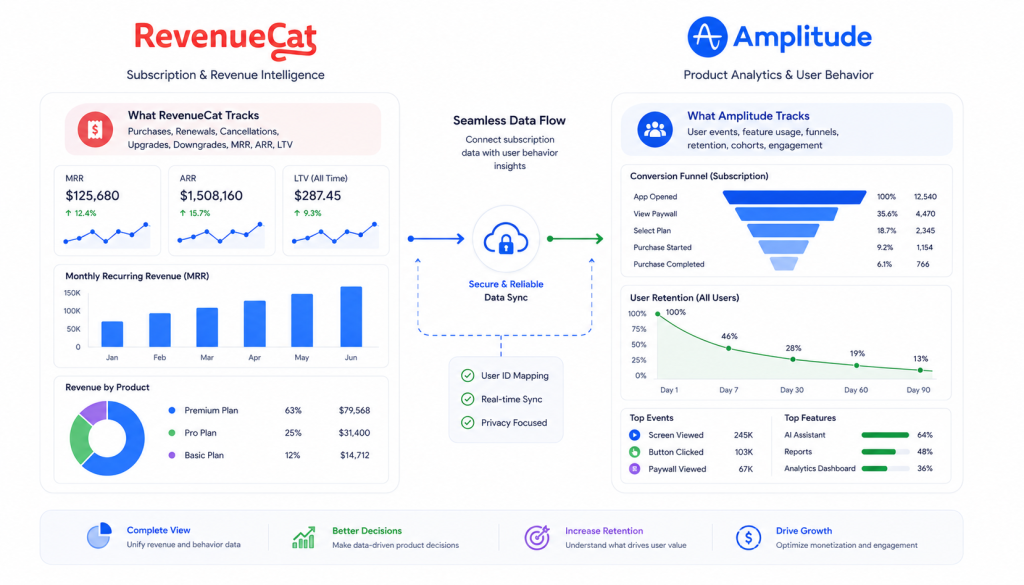
If you’re building a subscription mobile app, you’ve probably asked this question: should I use RevenueCat or Amplitude to track my subscription revenue?
The short answer: you need both — but for different reasons.
RevenueCat and Amplitude solve different problems. Using one without the other leaves critical gaps in your subscription analytics. This guide breaks down exactly what each tool does, where they overlap, and how to combine them for complete subscription revenue tracking.
In this guide:
- What RevenueCat does and why subscription apps need it
- What Amplitude does and where it excels
- RevenueCat vs Amplitude: direct comparison
- How to integrate RevenueCat with Amplitude
- Which tool to use for which use case
- Building the complete subscription analytics stack
What Is RevenueCat?
RevenueCat is a subscription management and revenue tracking platform purpose-built for mobile apps. It handles the complexity of in-app purchases across iOS and Android so you don’t have to.
What RevenueCat does:
- Manages App Store and Google Play subscriptions from one SDK
- Tracks trial starts, conversions, renewals, cancellations, and churns
- Provides real-time revenue dashboards (MRR, ARR, LTV)
- Handles receipt validation server-side
- Sends subscription events to your analytics tools and MMPs
Why subscription apps need RevenueCat:
Without RevenueCat, tracking subscriptions across iOS and Android requires:
- Separate App Store Connect and Google Play Console integrations
- Custom server-side receipt validation
- Manual event tracking for every subscription state change
- Complex logic for trial periods, grace periods, and billing retries
RevenueCat handles all of this out of the box.
What Is Amplitude?
Amplitude is a product analytics platform. It helps you understand user behavior inside your app — what users do, where they drop off, and what drives retention and revenue.
What Amplitude does:
- Tracks user events and behavior flows
- Builds funnels, retention curves, and cohort analysis
- Identifies which features drive conversion and LTV
- Provides behavioral segmentation and user journeys
- Supports A/B testing and experimentation
Why subscription apps need Amplitude:
RevenueCat tells you what happened with revenue. Amplitude tells you why.
- Which onboarding flow leads to higher trial conversions?
- What behavior predicts a user will cancel?
- Which features do your highest LTV users engage with most?
- Where do users drop off before hitting the paywall?
These questions require Amplitude.
RevenueCat vs Amplitude: Direct Comparison
| Feature | RevenueCat | Amplitude |
|---|---|---|
| Subscription management | ✅ Core feature | ❌ Not available |
| Receipt validation | ✅ Server-side | ❌ Not available |
| MRR / ARR tracking | ✅ Real-time | ⚠️ Via events only |
| Trial tracking | ✅ Automatic | ⚠️ Manual setup |
| Churn prediction | ⚠️ Basic | ✅ Strong |
| User behavior analysis | ❌ Limited | ✅ Core feature |
| Funnel analysis | ❌ Not available | ✅ Advanced |
| Retention analysis | ❌ Not available | ✅ Advanced |
| A/B testing | ❌ Not available | ✅ Available |
| MMP integration | ✅ AppsFlyer, Adjust | ⚠️ Limited |
| Price | Free up to $2.5k MRR | Free up to 10M events |
The verdict:
RevenueCat wins for subscription revenue tracking. Amplitude wins for user behavior and product analytics. Neither replaces the other.
RevenueCat vs Amplitude: Use Case Breakdown
Use RevenueCat when you need to:
- Know your exact MRR, ARR, and LTV in real-time
- Track trial-to-paid conversion rates accurately
- Understand churn by subscription tier or country
- Send subscription events to AppsFlyer or Adjust for attribution
- Validate purchases server-side without custom code
- Manage entitlements across iOS and Android
Use Amplitude when you need to:
- Understand which user behaviors lead to subscription conversion
- Build onboarding funnels and identify drop-off points
- Segment users by behavioral cohorts
- Run A/B tests on features and flows
- Predict which users are likely to churn based on behavior
- Analyze retention by acquisition source or user segment
How to Integrate RevenueCat with Amplitude
The real power comes from combining both tools. RevenueCat can send subscription events directly to Amplitude, giving you revenue data alongside behavioral data in one place.
Step 1 — Enable Amplitude Integration in RevenueCat
- RevenueCat Dashboard → Integrations → Amplitude
- Enter your Amplitude API Key
- Select which events to send
Step 2 — Choose Which Events to Send
RevenueCat sends these subscription events to Amplitude:
| RevenueCat Event | What It Means |
|---|---|
rc_initial_purchase | First paid subscription |
rc_trial_started | Free trial begins |
rc_trial_converted | Trial converts to paid |
rc_trial_cancelled | Trial cancelled before conversion |
rc_renewal | Subscription renewed |
rc_cancellation | Subscription cancelled |
rc_billing_issue | Payment failed |
rc_product_change | User changed subscription tier |
Step 3 — Map RevenueCat User ID to Amplitude User ID
For events to connect properly, both tools need to use the same user identifier.
// iOS — Set same user ID in both SDKs
let userId = "user_12345"

// RevenueCat
Purchases.shared.logIn(userId) { customerInfo, created, error in }

// Amplitude
Amplitude.instance().setUserId(userId)// Android — Set same user ID in both SDKs
val userId = "user_12345"
// RevenueCat
Purchases.sharedInstance.logIn(userId) { customerInfo, created, error -> }
// Amplitude
Amplitude.getInstance().userId = userIdStep 4 — Verify Events in Amplitude
- Go to Amplitude → Events
- Search for
rc_initial_purchaseorrc_trial_started - Verify events are appearing with correct properties
Step 5 — Build Subscription Funnels in Amplitude
Once RevenueCat events are flowing into Amplitude, build these funnels:
Trial Conversion Funnel:
App Install → Onboarding Complete → Paywall View → Trial Started → Trial ConvertedChurn Analysis:
Subscription Active → Feature Engagement → Cancellation → Exit SurveyRevenueCat + Amplitude + AppsFlyer: The Complete Stack
For subscription apps running paid UA campaigns, you need all three:
| Tool | Purpose |
|---|---|
| AppsFlyer / Adjust | Install attribution — which campaign drove the install |
| RevenueCat | Subscription management — which users converted and churned |
| Amplitude | Product analytics — why users convert and churn |
Data flow:
Ad Campaign → Install (AppsFlyer) → App Behavior (Amplitude) → Subscription (RevenueCat) → RevenueThis combination answers the complete question:
- Which campaign drove the install? (AppsFlyer)
- What did the user do before subscribing? (Amplitude)
- Did they stay subscribed? (RevenueCat)
Common Subscription Tracking Mistakes
Mistake 1 — Relying Only on App Store Connect
App Store Connect shows revenue, but with a 1-3 day delay and no user-level data. RevenueCat gives you real-time data with user-level granularity.
Mistake 2 — Tracking Subscriptions as Custom Events in Amplitude
Many teams try to track purchases as custom events in Amplitude. This misses renewal tracking, receipt validation, and accurate MRR calculation. Use RevenueCat for subscription tracking.
Mistake 3 — Not Matching User IDs Across Tools
If RevenueCat and Amplitude use different user IDs, you can’t connect subscription events to behavioral data. Always set the same user ID in both SDKs immediately after login.
Mistake 4 — Ignoring Trial Cancellations
Most teams track trial starts and conversions but miss trial cancellations. RevenueCat tracks rc_trial_cancelled automatically — send this to Amplitude to understand why users cancel before converting.
Mistake 5 — Not Sending RevenueCat Events to Your MMP
AppsFlyer and Adjust need subscription events to calculate true ROAS. Connect RevenueCat to your MMP so revenue data is included in campaign attribution.
FAQ
Is RevenueCat better than Amplitude for subscription tracking? They serve different purposes. RevenueCat is purpose-built for subscription management and revenue tracking. Amplitude is for user behavior and product analytics. Most subscription apps need both.
Can I use Amplitude instead of RevenueCat? You can track subscription events in Amplitude, but you’ll miss receipt validation, entitlement management, and accurate MRR calculation. RevenueCat handles subscription complexity that Amplitude wasn’t designed for.
Does RevenueCat integrate with AppsFlyer? Yes. RevenueCat has a native AppsFlyer integration. It sends subscription events directly to AppsFlyer so you can see subscription revenue in your attribution reports.
How much does RevenueCat cost? RevenueCat is free up to $2,500 MRR. Above that, pricing is based on a percentage of tracked revenue. Most early-stage apps stay on the free tier.
What is the difference between RevenueCat and Amplitude? RevenueCat manages subscriptions and tracks revenue. Amplitude analyzes user behavior. RevenueCat tells you what happened with money. Amplitude tells you why users behave the way they do.
Can RevenueCat replace Firebase Analytics? No. RevenueCat tracks subscription events only. Firebase Analytics tracks all in-app events and user behavior. They complement each other.
How do I track subscription LTV in mobile apps? Use RevenueCat for subscription revenue data and connect it to Amplitude or your data warehouse. RevenueCat calculates LTV automatically in its dashboard, while Amplitude lets you segment LTV by user behavior and acquisition source.
For more details, visit the RevenueCat official documentation and Amplitude documentation.