Multi-Tenant WhatsApp Cloud API: 6 Questions Before You Build
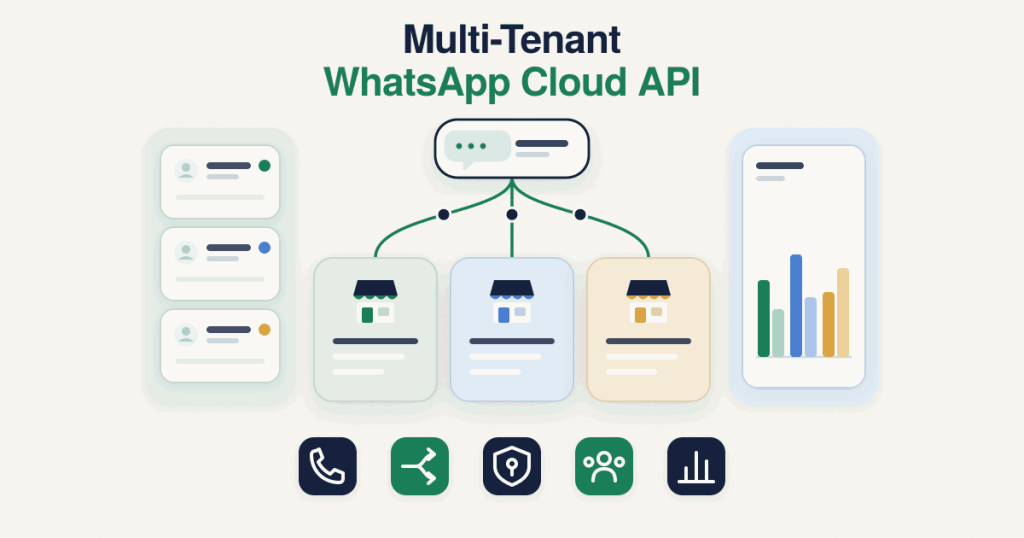
A multi-tenant WhatsApp Cloud API setup is one Cloud API system that serves several businesses, branches or brands at once. Each message is routed to the right business, each keeps its own data and reports, and staff see only what belongs to them, while the owner sees everything from one place.The appeal is obvious when you run more than one thing. One setup to maintain, one dashboard to open, one place where every lead and every entry lands. The catch is just as real, and most owners only find it after the fact: a multi-tenant WhatsApp Cloud API shares some things across every business whether you want it to or not, and sharing the wrong thing can drag a healthy brand down with a struggling one. This post is about knowing which is which before you build.
Can one WhatsApp number serve several businesses?
Yes, when the businesses are branches or units under one brand. A chain with five outlets, or a group whose divisions share a name, can sit comfortably behind one number because the customer sees one display name and is not confused by it. The software behind that number can still separate each branch’s leads, bookings and records cleanly.Unrelated brands are the harder case. A customer messaging what they think is “Brand A” should not see “Brand B” as the sender name, so two brands with nothing in common usually need their own numbers. The deciding question is not technical, it is what the customer expects to see when they open the chat.
How one WhatsApp number for multiple businesses routes each message
One WhatsApp number for multiple businesses works by sorting each conversation to the right place at the start. The first message triggers a short menu or a keyword step, the contact’s choice is saved against their record, and from then on their messages flow straight to that business without asking again.Staff never see the whole stream. A team member assigned to one business sees only that business’s conversations, and an incoming message they are not responsible for simply does not appear in their inbox. The routing rule and the permission rule work together: one decides where a message goes, the other decides who is allowed to open it.
How does a multi-tenant WhatsApp Cloud API keep data separate?
A multi-tenant WhatsApp Cloud API enforces separation in the data model, not by being careful. Every record, whether a lead, a message or a bookkeeping entry, carries a tenant ID that marks which business it belongs to. Nothing is read or written without that ID in the query, so one business’s data cannot surface inside another’s by accident.On top of that sit roles and reporting. Staff get permissions scoped to their business, the owner gets a view across all of them, and reports are generated per tenant so each business’s totals stand on their own. If bookkeeping is part of the setup, the same rule applies there: expenses and income are filed under the right business from the moment they are captured, which is covered in more depth in
WhatsApp AI bookkeeping.
One number or one number per business?
This is the decision that matters most, and it is worth laying the trade-offs side by side rather than guessing.
| One shared number | One number per business |
|---|
| Display name | One name every business shares | Each business its own name |
| Customer trust | Clean for branches, confusing for unrelated brands | Clear, each brand looks like itself |
| Template approval | One set of templates to manage | Separate templates per number |
| Quality and limits | Shared across the portfolio, one bad actor affects all | Isolated, a problem stays with its own number |
| Running cost | Lower, one setup to maintain | Higher, more numbers and upkeep |
| Setup effort | More design work for routing and separation | Simpler per number, repeated each time |
The row that catches people out is quality and limits. On WhatsApp these are measured for the whole business portfolio and shared by every number in it, not calculated per number. So if one brand on a multi-tenant WhatsApp Cloud API sends messages that get marked as unwanted, the messaging limits and quality signals that follow can affect the others too. For branches of one trusted brand that risk is small. For a cluster of unrelated brands with different standards, it is a real reason to keep them apart.
Can one WhatsApp Business Account hold several numbers?
No, not on the current account model. Meta has changed the structure. A WhatsApp account now holds a single business phone number and represents one business presence on WhatsApp. To arrange several numbers, you link multiple WhatsApp accounts together rather than putting many numbers under one account.Billing and templates live in a separate Messaging account, and each partner you work with gets its own. One point to clear up if you have the old term in your head: an existing WABA ID now identifies the Messaging account, not a WhatsApp account. The ID and field name are unchanged, so your existing API calls still work. The current limits on how many you can hold live on the
Meta business messaging changes reference, so check there when you plan.Because of this, the structure has to be decided before you register numbers, not rearranged by moving a number later. Phone number migration between providers is not supported on the new model, so a number does not simply move out. Settle how many businesses and numbers you need up front, because the shape you register is the shape you build on.
What about serving other companies’ WhatsApp accounts?
Everything above assumes the businesses are yours. Serving other companies, where each client keeps their own WhatsApp Business Account and you operate on top of it, is a different model called the Tech Provider path, using Meta’s Embedded Signup so a client can connect their own account to your system. Getting approved for that route starts with
WhatsApp business verification.That route carries its own Meta requirements and review, and it is a bigger undertaking than running your own group on one setup. It is worth knowing the option exists, but for most owners reading this the question is about their own branches or brands, which is what the rest of this post covers.
Where this fits in a WhatsApp business management system
A multi-tenant WhatsApp Cloud API is one layer of a wider WhatsApp business management system: one Cloud API number carrying several focused tools, each scoped to its task, all feeding one dashboard the owner reviews. Lead capture, bookings, stock and bookkeeping can each run per business behind the same number, with the tenant separation holding it all apart underneath.I build these as custom work on your own WhatsApp Business numbers, starting from how your businesses are actually structured rather than forcing them into a template. If you are weighing one number against many for a group or agency, the
WhatsApp CRM and Cloud API setup page covers how I scope and build it, and the
WhatsApp CRM case study shows the process on a real build.
Frequently asked questions
Will customers know several businesses share one number?
They see the display name on the number, not the structure behind it. For branches of one brand that is exactly right. For unrelated brands it is the reason to use separate numbers, because the shared name would confuse them.
If one brand gets flagged, does it hurt the others?
It can. Messaging limits and quality are measured across the whole business portfolio and shared by every number in it, so a problem on one can affect the rest. This is the strongest argument for keeping unrelated brands on separate numbers.
Can staff be stopped from seeing other businesses’ chats?
Yes. Permissions are scoped per business, so a team member assigned to one sees only its conversations and records. A message outside their business does not appear in their inbox at all.
Can each business have its own reports and totals?
Yes. Reporting is generated per tenant, so each business’s leads, bookings and financial totals stand on their own while the owner keeps a combined view across all of them.
Can I start with one number and split later?
Plan the structure first. On the new account model a business phone number does not simply migrate out, so you cannot cleanly move a brand onto its own number after the fact. Decide how many numbers you need before you register, and tell me how your businesses are arranged so I can design for where you are heading.
Does this work for an agency managing clients?
Managing your own group is one model, and serving clients who keep their own WhatsApp Business Accounts is the Tech Provider path, which is a larger build with its own Meta requirements. Say which one you need and I will scope the right approach.